How Space Travel Affects the Heart Health?

Human space exploration pushes the limits of science, technology, and medicine. Researchers have long studied how living beyond Earth’s gravity affects the body — especially the cardiovascular system. Because the heart evolved under gravity, it faces unique stresses in space. Understanding these changes is central to protecting astronaut health during missions ranging from weeks aboard the International Space Station to future journeys to Mars.
Why Space Affects the Heart
Gravity shapes how blood circulates on Earth, where the heart must pump against gravity to move blood from the legs to the brain. In microgravity, this challenge disappears, triggering rapid physiological adaptations.
Fluid Shifts and Blood Volume Changes
When astronauts enter space, fluids shift from the lower body toward the chest and head. This headward shift increases central blood volume and signals the body that there is excess fluid. As a result:
- The kidneys remove fluid, lowering total blood volume
- Blood pressure regulation changes
- Heart chambers remodel due to reduced workload
These mechanisms are documented in NASA research on cardiovascular changes in microgravity.
https://www.nasa.gov/missions/station/cardiovascular-health-in-microgravity/
Cardiovascular Deconditioning in Space
The cluster of changes caused by spaceflight — called cardiovascular deconditioning — includes structural, functional, and regulatory changes in the heart and blood vessels.
Heart Muscle Atrophy and Remodeling
Like other muscles, the heart unloads in microgravity, leading to reduced muscle mass and weaker contraction. Engineered human heart tissue sent to the ISS showed weaker contraction and irregular beating after exposure to microgravity.
https://www.sciencedaily.com/releases/2024/09/240923151751.htm
Astronaut imaging studies also show that:
- The heart can become smaller during long missions
- Arterial walls may stiffen
- Cardiac output and blood distribution change after return to Earth
These changes resemble accelerated cardiovascular aging but are generally reversible with rehabilitation.
Changes in Vascular Function
Microgravity also alters blood vessel behaviour. Reduced fluid shear stress can affect endothelial cells and vascular repair mechanisms. NASA studies examining microRNA and vascular repair aim to understand these cellular responses.
https://www.nasa.gov/mission_pages/station/research/experiments/2902.html
Astronauts may also experience orthostatic intolerance — dizziness or fainting when standing after returning to Earth due to impaired blood pressure regulation.
https://www.nasa.gov/directorates/esdmd/hhp/cardiovascular-and-vision/
Heart Rhythm and Electrical Function
Spaceflight may also affect cardiac electrical activity. Researchers have observed:
- Changes in heart rate variability
- Occasional increases in ectopic beats
- Altered autonomic nervous system control after return
Evidence of increased ventricular ectopy during missions has been reported, though long-duration data remain limited.
https://pubmed.ncbi.nlm.nih.gov/37531984/
Radiation and Long-Term Cardiovascular Risk
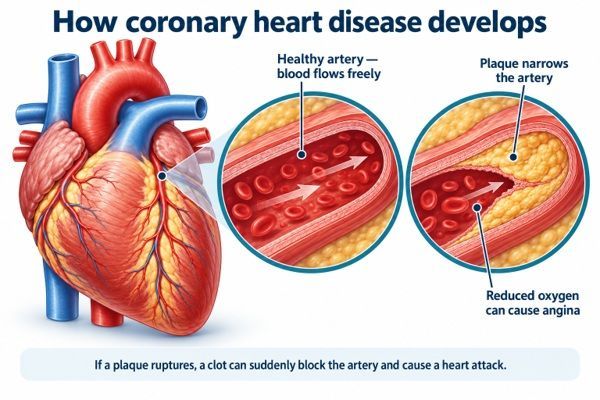
Outside Earth’s protective atmosphere, astronauts are exposed to cosmic radiation. High-energy particles can damage cells and DNA, potentially raising long-term cardiovascular disease risk.
A 2023 systematic review suggests that exposure to space radiation may contribute to accelerated atherosclerosis.
https://pubmed.ncbi.nlm.nih.gov/37531984/
Measuring Cardiovascular Health in Space
To study these effects, researchers use several tools aboard the ISS:
- Vascular Echo ultrasound imaging of heart and arteries
- Engineered Heart Tissues that model cardiac cell behaviour in microgravity
- Wearable monitors tracking heart rhythm, blood pressure, and stroke volume
https://www.nature.com/articles/s41526-025-00522-8
These experiments help detect early cardiovascular changes during missions.
Exercise and Countermeasures
Modern space medicine relies heavily on countermeasures to prevent deconditioning. Astronauts aboard the ISS perform daily exercise using:
- Treadmills with harness systems
- Stationary bicycles
- Resistive devices that simulate weightlifting
Regular exercise helps preserve heart function, muscle mass, and blood volume, reducing cardiovascular decline during missions.
Returning to Earth
After landing, astronauts often experience difficulty readapting to gravity, including:
- Dizziness from impaired blood pressure regulation
- Reduced aerobic capacity
- Temporary heart rhythm changes
NASA medical teams monitor returning crews closely and use rehabilitation programs to restore cardiovascular function.
Clinical Relevance on Earth
Space research also benefits medicine on Earth. Many cardiovascular changes seen in space resemble those from aging or chronic disease:
- Reduced blood volume mirrors prolonged bedrest
- Vascular stiffening resembles hypertension and atherosclerosis
- Cellular studies inform heart failure research
Spaceflight removes the normal gravitational load on the body, triggering “aging-like” cardiovascular deconditioning such as arterial stiffening, reduced fitness, and insulin resistance.
https://www.nature.com/articles/nrcardio.2017.157
What NASA Has Taught Us
Space medicine research shows that:
- Microgravity rapidly alters cardiovascular function
- Exercise countermeasures are essential
- Continuous monitoring is critical during missions
- Many changes reverse after returning to gravity
Future Missions and Research
As missions extend toward Mars and deeper space, maintaining astronaut heart health becomes even more important. Longer exposure to microgravity and radiation could increase cardiovascular risks over decades.
Summary
Space travel affects the cardiovascular system through:
- Fluid redistribution
- Cardiac remodeling and muscle loss
- Altered vascular function
- Potential rhythm disturbances
Although many changes resemble accelerated aging, research shows they can often be mitigated with countermeasures. Continued space medicine studies will protect astronauts while also advancing cardiovascular science and treatment on Earth.
Future research priorities include:
- Long-term cardiovascular studies in deep space missions
- Improved modeling of heart responses to microgravity
- Radiation protection strategies
- Personalized countermeasures based on astronaut physiology.